





SQL vs NoSQL: Relational and Non-Relational Databases Explained
June 29, 2026One of the most important decisions in any software design is choosing the right database. In this article we explain the difference between SQL (relational) and NoSQL (non-relational) databases in plain language, so you can decide which fits your project.
What Is an SQL (Relational) Database?
SQL databases store data in tables with a fixed schema of rows and columns, and manage relationships between tables using foreign keys. Popular examples include MySQL, PostgreSQL, and SQL Server. Their query language is standardized and powerful:
SELECT name, email
FROM users
WHERE created_at > '2025-01-01'
ORDER BY name;
What Is a NoSQL (Non-Relational) Database?
NoSQL databases are built for flexibility and high scalability, and come in several types: document (MongoDB), key-value (Redis), column (Cassandra), and graph (Neo4j). They usually do not require a fixed schema:
db.users.find({
  created_at: { $gt: "2025-01-01" }
}).sort({ name: 1 })
Key Differences Between SQL and NoSQL
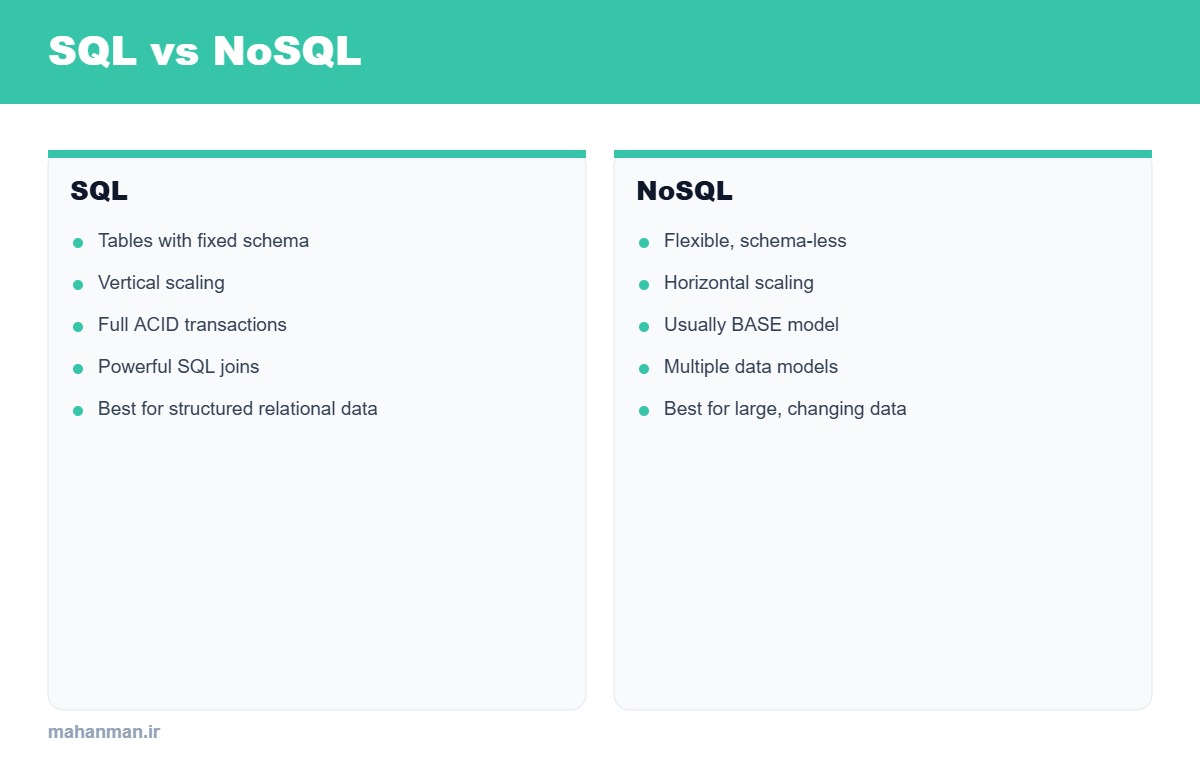
| Feature | SQL | NoSQL |
|---|---|---|
| Structure | Tables with fixed schema | Flexible, schema-less |
| Scaling | Vertical | Horizontal |
| Transactions | Full ACID support | Usually BASE |
| Best for | Structured data, complex relations | Large, changing data |
When to Use SQL vs NoSQL
If your data is structured, has complex relationships, and transactional integrity is critical (such as financial and banking systems), SQL is the safer choice. But if you face very high data volume, a changing structure, or need fast horizontal scaling (such as social networks, logs, and IoT), NoSQL performs better. In many real-world projects, a combination of both is used.
Frequently Asked Questions
Is NoSQL faster than SQL? Not necessarily; speed depends on the query type and access pattern. NoSQL excels at simple reads/writes and high scale, while SQL is stronger for complex queries and joins.
Which is better for a startup? If your data model is still changing, NoSQL offers flexibility, but PostgreSQL with JSON support is an excellent middle-ground option.
Conclusion
Neither SQL nor NoSQL is universally better; the right choice depends on your project’s needs. Weigh your data structure, transaction requirements, and scaling pattern, and decide accordingly. In many modern architectures, using both together (Polyglot Persistence) is common.
