






Types of Databases Explained: A Complete Guide to 6 Database Models
July 2, 2026When people talk about databases, many only know SQL and NoSQL; but in practice there are several database types with different use cases. In this article we review the main types so you can pick the best one for each scenario.
1) Relational Database
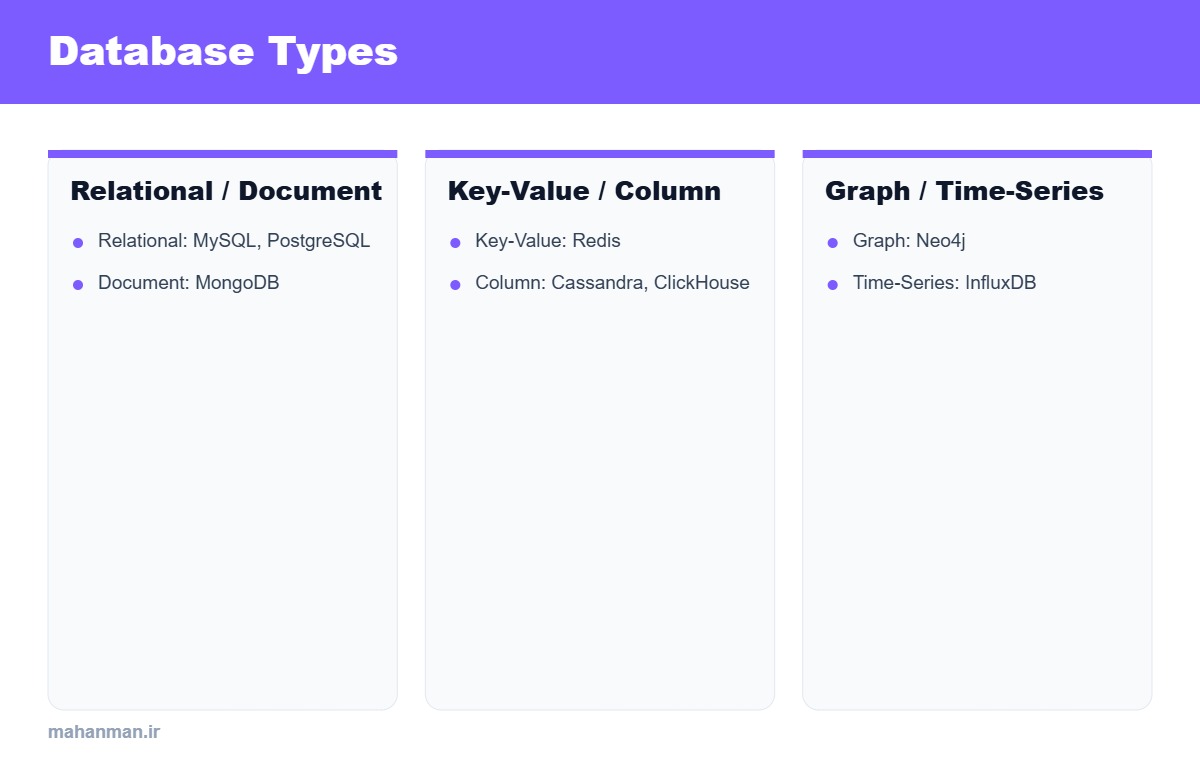
Data is stored in related tables and queried with SQL. Examples: MySQL, PostgreSQL. Best for structured data and complex relationships.
2) Document Database
Data is stored as JSON-like documents with a flexible schema. Example: MongoDB. Best for changing data and rapid development.
3) Key-Value Database
The simplest model: each value is stored under a unique key. Very fast. Example: Redis. Best for caching, sessions, and queues.
4) Column-Family Database
Data is stored by column, which is great for analyzing large volumes of data. Examples: Cassandra, ClickHouse. Best for analytics and logs.
5) Graph Database
Relationships between data are modeled as nodes and edges. Example: Neo4j. Best for social networks, recommendation systems, and fraud detection.
6) Time-Series Database
Optimized for timestamped data such as sensors and monitoring. Examples: InfluxDB, TimescaleDB.
Which One Should You Choose?
Look at your access pattern and data type: complex relations → relational, changing structure → document, speed and caching → key-value, heavy analytics → column, network relationships → graph, time data → time-series.
Frequently Asked Questions
Can you use multiple database types together? Yes, this approach is called Polyglot Persistence and is very common in modern architectures.
Conclusion
No single database is best for everything. Knowing the database types helps you pick the right tool for each part of your system and improve your project’s performance and scalability.
