






Concurrency vs Parallelism: Process, Thread, and Coroutine Explained
July 8, 2026Two terms that are often confused: Concurrency and Parallelism. Although they sound alike, they are different concepts. In this article we clarify the difference, along with the concepts of Process, Thread, and Coroutine.
What Is Concurrency?
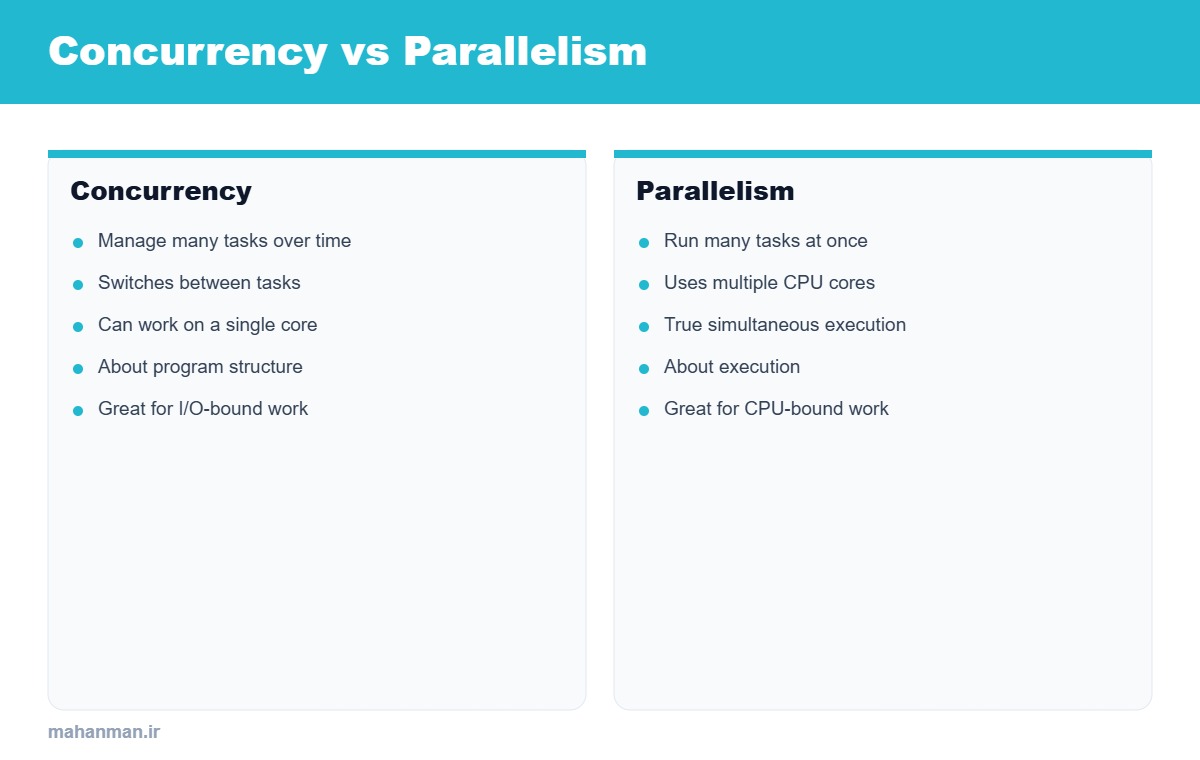
Concurrency means managing multiple tasks over a period of time, not necessarily at the same instant. The system switches quickly between tasks so they appear to progress together. Like a cook managing several dishes by switching between them.
What Is Parallelism?
Parallelism means truly running multiple tasks at the same instant, on multiple CPU cores. Like several cooks each preparing one dish. Parallelism requires multi-core hardware.
The Main Difference
Concurrency is about the structure of your program (how you split tasks), parallelism is about simultaneous execution. You can have concurrency without parallelism (one core), and parallelism is a form of concurrency that actually runs at the same time.
Process, Thread, and Coroutine
Process: an independent program with separate memory; safe but heavy. Thread: a lighter unit inside a process that shares memory; faster but requires careful management. Coroutine: a lightweight, language-level concurrency unit (like async in Python and JavaScript) that gives high concurrency without the overhead of system threads.
When to Use Which?
For I/O-bound work (network, database), concurrency with coroutines is excellent. For CPU-bound work (heavy computation), parallelism with multiple processes or threads pays off.
Frequently Asked Questions
Is async in JavaScript parallel? No; JavaScript is single-threaded and its async is concurrency, not true parallelism.
Conclusion
Concurrency means “dealing with many tasks”, parallelism means “doing many tasks at once”. The right choice between Process, Thread, and Coroutine depends on your workload type (I/O or CPU).
