





Containers vs Virtual Machines: A Complete Docker Guide
July 26, 2026With the popularity of Docker and containers, a common question arises: what is the difference between a Container and a Virtual Machine (VM)? Both are used to isolate applications but work at different levels. In this complete guide we examine them with an example.
What Is a Virtual Machine (VM)?
A VM, with the help of a hypervisor, virtualizes the hardware, and each virtual machine runs a full, separate guest operating system. This means strong isolation, but high resource usage and slow startup (in minutes).
What Is a Container?
Instead of virtualizing the whole OS, a container shares the host OS kernel and packages only the application and its dependencies. The result: very small size (in megabytes), startup in seconds, and high density per host. Docker is the most popular tool in this space.
# simple Dockerfile example
FROM node:24-alpine
WORKDIR /app
COPY . .
RUN npm install
CMD ["node", "server.js"]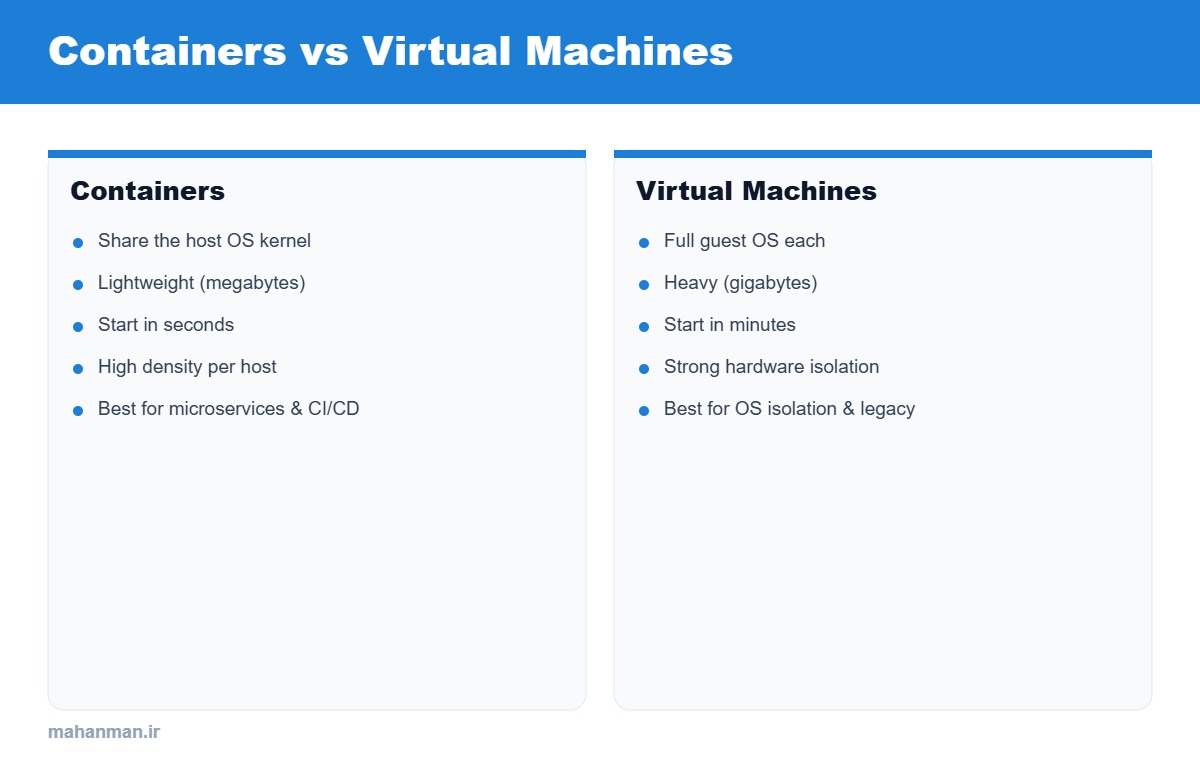
Key Differences
| Feature | Container | Virtual Machine |
|---|---|---|
| Operating system | Shared host kernel | Full separate OS |
| Size | Megabytes | Gigabytes |
| Startup speed | Seconds | Minutes |
| Isolation | Process level | Strong (hardware) |
When to Use Which?
For microservices, CI/CD, and fast, lightweight deployment, containers are the first choice. When you need very strong isolation, a different OS, or legacy systems, a VM is more suitable. In practice, containers often run inside VMs to get the benefits of both.
Frequently Asked Questions
Are containers more secure than VMs? In terms of isolation, VMs have a stronger boundary; but containers can be well secured with the right configuration.
Is Docker the same as a container? Docker is the most popular tool for building and running containers, but a container is a more general concept.
Conclusion
VMs virtualize the operating system and provide strong isolation; containers share the kernel and are lightweight and fast. The right choice depends on your isolation, speed, and scaling needs, and a combination of both often gives the best result.
