






Session vs JWT vs OAuth: A Complete Guide to Authentication Methods
July 17, 2026Authentication is one of the foundations of every application’s security. The three most common methods today are Session, JWT, and OAuth. In this complete guide we examine the differences, pros, cons, and proper use cases of each.
What Is Session-Based Authentication?
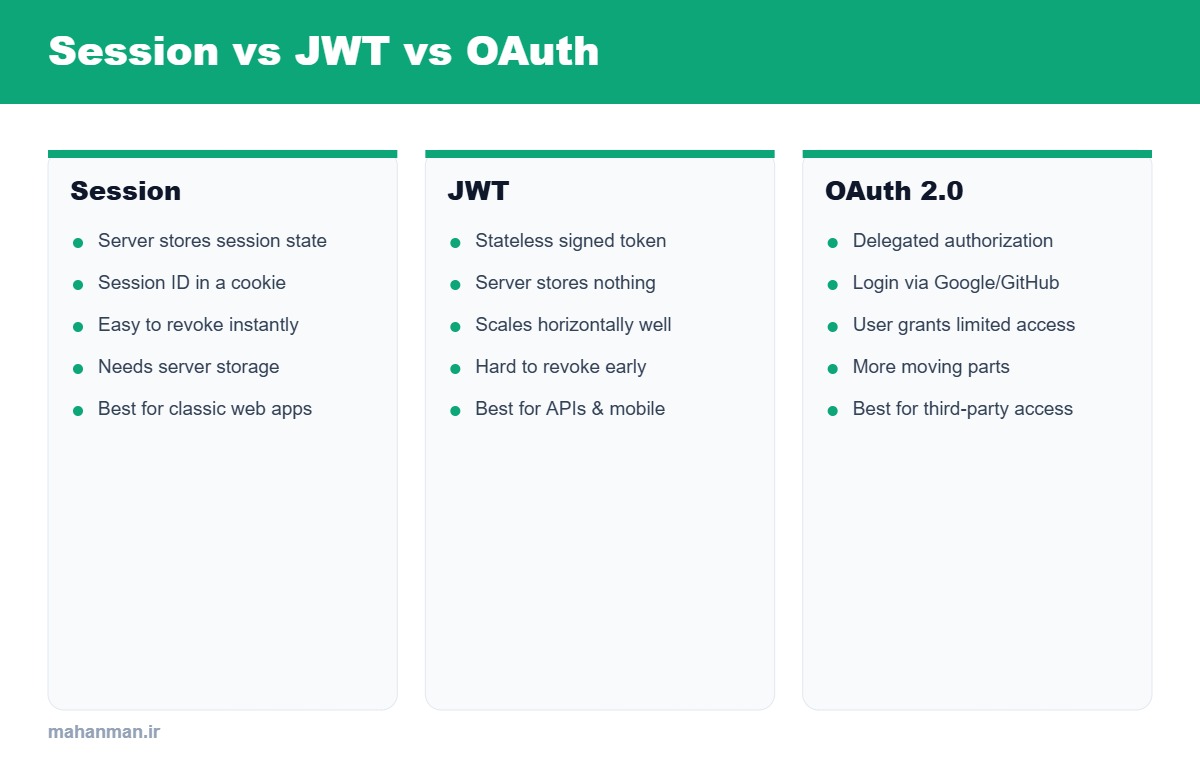
In this method, after the user logs in, the server creates a “session” and stores its state; a session ID is saved in a browser cookie and sent with every request. The server identifies the user by that ID. This approach is stateful.
What Is JWT-Based Authentication?
A JSON Web Token is a signed, self-contained (stateless) token that carries user information. The server stores nothing and only verifies the token’s signature. This makes horizontal scaling simple.
// example structure of a JWT
header.payload.signature

// on each request:
Authorization: Bearer
What Is OAuth 2.0?
OAuth is an “authorization delegation” protocol, not just authentication. It lets a user log in with their Google/GitHub account without sharing a password and grant limited access to the application. It is often used together with JWT.
Key Differences
| Feature | Session | JWT | OAuth |
|---|---|---|---|
| State | Stateful | Stateless | Delegation protocol |
| Revocation | Instant & easy | Hard until expiry | Managed via tokens |
| Best for | Classic web | APIs & mobile | Third-party login |
When to Use Which?
For a classic web application with a single server, Session is simple and secure. For APIs, mobile apps, and scalable architectures, JWT is a good option. When you want users to log in with Google/GitHub or grant limited access to third-party apps, OAuth is required.
Frequently Asked Questions
Is JWT more secure than Session? Not inherently; each has its own threat model. JWT’s main drawback is the difficulty of revoking it before expiry.
Does OAuth replace JWT? No; they are complementary. OAuth defines the access flow and often uses JWT as the token.
Conclusion
Session keeps state on the server, JWT carries it in the token, and OAuth delegates access. The right choice depends on client type, scaling needs, and login scenario; combining OAuth + JWT is very common in modern systems.
