






Caching Explained: Redis vs Memcached and Cache Strategies
July 20, 2026Caching is one of the most effective techniques for boosting speed and reducing database load. Two popular tools in this area are Redis and Memcached. In this complete guide we cover the concept of caching, its strategies, and the differences between these two tools.
What Is a Cache and Why Does It Matter?
A cache is a fast storage layer (usually in RAM) that keeps frequently used results so they can be served instantly instead of recomputing or re-querying the database. The result: lower response time and less load on the server and database.
// common Cache-Aside pattern
value = cache.get(key)
if (value == null) {
  value = db.query(key)   // only when not cached
  cache.set(key, value, ttl=300)
}
return value
What Is Redis?
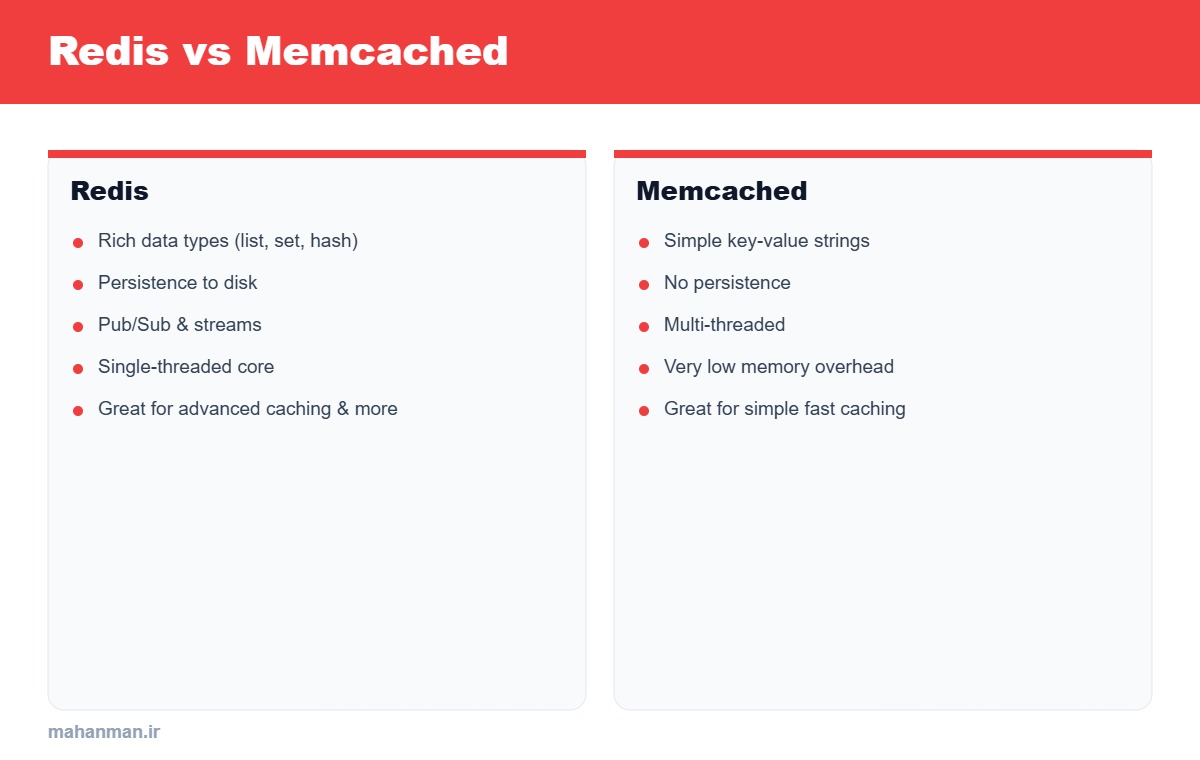
Redis is a feature-rich in-memory data store: advanced data types (list, set, hash, sorted set), disk persistence, Pub/Sub, and streams. That is why it is more than a cache; it is sometimes used as a database and a queue too.
What Is Memcached?
Memcached is a simple, extremely fast key-value cache that stores only strings, has no persistence, and uses a multi-threaded architecture. Its focus is simplicity and high-volume caching with low memory overhead.
Key Differences
| Feature | Redis | Memcached |
|---|---|---|
| Data types | Rich (list, set, hash…) | Strings only |
| Persistence | Yes | No |
| Execution model | Single-threaded core | Multi-threaded |
| Use case | Advanced cache, queue, Pub/Sub | Simple, fast cache |
Caching Strategies
The most common patterns are Cache-Aside (the app fills the cache itself), Write-Through (writing to cache and database at once), and Write-Back. Setting an expiry time (TTL) and a cache-invalidation strategy is key to avoiding stale data.
When to Use Which?
If you only need a simple, fast key-value cache, Memcached is lightweight and sufficient. If you need advanced data types, persistence, a queue, or Pub/Sub, Redis is the more powerful and today more widely used choice.
Frequently Asked Questions
Can Redis replace a database? In specific cases yes, but it is usually used alongside the main database as a fast layer.
Which is faster? Both are very fast; in simple scenarios the difference is negligible and the choice depends more on features.
Conclusion
Caching is one of the simplest ways to achieve a performance leap. Memcached is excellent for simple caching, and Redis is an all-rounder with rich features. First assess your project’s real needs, then choose the tool.
